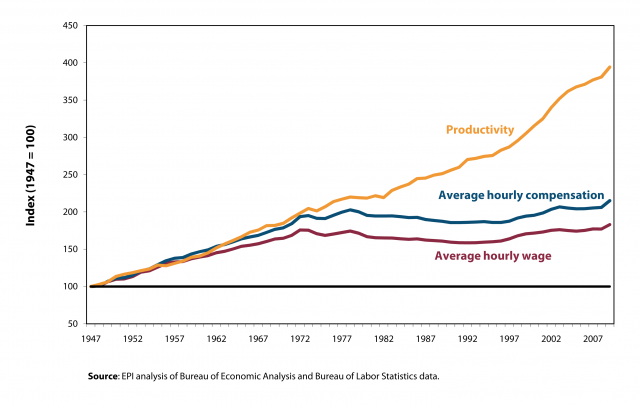
I’ve said this before in other venues, but this really is chart that explains modern America:Not to mention how this is undermining the functioning of our democratic republic.
It’s the famous wage/productivity chart, showing the cleavage around 1973 and the far greater discrepancy after the 1980s recession. Basically we’ve been living with the consequences of this wage/productivity gap ever since.
And I tend to think it explains every single economic challenge that we face. It clearly stands in for inequality, as all the wealth accumulated from the productivity gains does go somewhere, mainly into the hands of a rentier class. The over-financialization of the economy sprouted as a way to manage and divert these productivity gains after they didn’t flow to labor, in addition to demanding that these gains not get plowed back into wages. Flat wages play a part in ever-expanding credit bubbles, in the low savings rate and the easy enticement of get-rich quick schemes or simply desperate borrowing to maintain standards of living. The skyrocketing cost of tuition and the subsequent student debt bubble comes with the bill of sale that the only way to escape wage stagnation is to shuffle through the meritocratic assembly line and purchase more and more education (this is a chimera, as wage growth has slowed for college graduates as well, and student debt additionally hinders prosperity). Wage stagnation is at the heart of our low household formation and the implications for construction and building trades. It’s why QE is more and more meaningless to a larger and larger class of wage-flatlined Americans (particularly Treasury purchases, at least in the view of that linked Jackson Hole paper). It defines the middle-class squeeze, the two-income trap, the inadequacy of retirement resources and the flow of so much of that system into the waiting arms of the financial services industry. I’m sure you could come up with something that doesn’t lead back into wage stagnation (climate change? I think I could argue it), but I think my point stands.
26 August 2013
Wages, Productivity and the State of the Economy
David Dayen:


Subscribe to:
Post Comments (Atom)


No comments:
Post a Comment