29 August 2013

Tax Breaks for Ministers

Now this is funny:  From Chris Bergen at Tax Analysts:
The other day, the Washington Post reported that Annie Laurie Gaylor, an atheist and the leader of a group called the Freedom From Religion Foundation(FFRA), is suing the government over what is known as the parsonage exemption. It seems that FFRA's board voted to give Gaylor and her husband a housing allowance (I'm betting to get standing for the suit) that they say they can't exclude from their income because they are not clergy.

Section 107 of the Internal Revenue Code states in part: "In the case of a minister of the gospel, gross income does not include -- (1) the rental value of a home furnished to him as part of his compensation, or (2) the rental allowance paid to him as part of his compensation . . ." Section 107 has been around for a while; note the archaic use of "him."

Now to the funny part. The government is arguing that the leader of an atheist group can qualify for a parsonage exemption. (I believe this is called the "please go away defense.") It seems belief in a deity is not a requirement to be a minister. But the taxpayer’s point is that she doesn’t want the exemption, for her or anyone else. And it’s probably a pretty good guess that she is not interested in promoting the gospel.

Let’s all say this together shall we: You can't make this stuff up!
Actually, the Code does indeed provide the allowance to a "minister of the gospel" which, technical speaking, would mean only Christians would qualify for the exclusion.  Thankfully, the IRS has ruled (Revenue Ruling 78-301) that the exclusion applies for Jewish rabbis, and presumably they've extended it for other religions as well.  But atheists?

Clearly this was a litigation strategy on the part of the DoJ.  I think they pretty much know the exclusion is a goner if a court actually has to rule on it.

Yes, predictably the right is up in arms about this.  This is the headline from Gateway Pundit: "Insane! DOJ Declares Atheism A “Religious Movement”, Eligible For Religious Tax Exemptions."

Bergen is reminded of this quote from a famous law professor: "Basic tax, as everyone knows, is the only genuinely funny subject in law school."

I must say I agree.

hat tip: ataxingmatter

PS:  By the way, the famous law professor? Marty Ginsburg, the late husband of our great Supreme Court justice....

IRS Goes All In on Same Sex Marriage (UPDATED)

The IRS has just issued a Revenue Ruling stating its position on the meaning of marriage under the Internal Revenue Code and, if you ask me, this is total victory:
There are more than two hundred Code provisions and Treasury regulations relating to the internal revenue laws that include the terms “spouse,” “marriage” (and derivatives thereof, such as “marries” and “married”), “husband and wife,” “husband,” and “wife.” The Service concludes that gender-neutral terms in the Code that refer to marital status, such as “spouse” and “marriage,” include, respectively, (1) an individual married to a person of the same sex if the couple is lawfully married under state law, and (2) such a marriage between individuals of the same sex. This is the most natural reading of those terms; it is consistent with Windsor, in which the plaintiff was seeking tax benefits under a statute that used the term “spouse,” 133 S. Ct. at 2683; and a narrower interpretation would not further the purposes of efficient tax administration.

In light of the Windsor decision and for the reasons discussed below, the Service also concludes that the terms “husband and wife,” “husband,” and “wife” should be interpreted to include same-sex spouses. This interpretation is consistent with the Supreme Court‟s statements about the Code in Windsor, avoids the serious constitutional questions that an alternate reading would create, and is permitted by the text and purposes of the Code.
And here's the kicker:
[I]ndividuals of the same sex will be considered to be lawfully married under the Code as long as they were married in a state whose laws authorize the marriage of two individuals of the same sex, even if they are domiciled in a state that does not recognize the validity of same-sex marriages. For over half a century, for Federal income tax purposes, the Service has recognized marriages based on the laws of the state in which they were entered into, without regard to subsequent changes in domicile, to achieve uniformity, stability, and efficiency in the application and administration of the Code. Given our increasingly mobile society, it is important to have a uniform rule of recognition that can be applied with certainty by the Service and taxpayers alike for all Federal tax purposes. Those overriding tax administration policy goals generally apply with equal force in the context of same-sex marriages.
This latter ruling - that married in one place means married everywhere - is consistent with the IRS' longstanding position on common law marriages:
In Revenue Ruling 58-66, the Service stated that a couple would be treated as married for purposes of Federal income tax filing status and personal exemptions if the couple entered into a common-law marriage in a state that recognizes that relationship as a valid marriage.

The Service further concluded in Revenue Ruling 58-66 that its position with respect to a common-law marriage also applies to a couple who entered into a common-law marriage in a state that recognized such relationships and who later moved to a state in which a ceremony is required to establish the marital relationship. The Service therefore held that a taxpayer who enters into a common-law marriage in a state that recognizes such marriages shall, for purposes of Federal income tax filing status and personal exemptions, be considered married notwithstanding that the taxpayer and the taxpayer's spouse are currently domiciled in a state that requires a ceremony to establish the marital relationship. Accordingly, the Service held in Revenue Ruling 58-66 that such individuals can file joint income tax returns under section 6013 of the Internal Revenue Code.

The Service has applied this rule with respect to common-law marriages for over 50 years, despite the refusal of some states to give full faith and credit to common-law marriages established in other states. Although states have different rules of marriage recognition, uniform nationwide rules are essential for efficient and fair tax administration. A rule under which a couple's marital status could change simply by moving from one state to another state would be prohibitively difficult and costly for the Service to administer, and for many taxpayers to apply.
As I say, this is total victory.  Really, after Windsor, I have no idea how they could reach any other conclusion.

Here is a link to the IRS New Release on the new ruling.  The ruling itself hasn't yet been posted on the IRS website (one of my subscription services has it, but their public website doesn't have it yet either), but when I will update this post with a link when it is available.

UPDATE:  Here is the full text of the ruling.


27 August 2013

How Nice of Them to Forgo Obamacare Benefits!

There's a story at Salon this morning about how two Republican Congressmen are declining Obamacare Benefits:
According to the Hendersonville Times News, Rep. Mark Meadows, R-N.C., who is leading the conservative effort in the House to oppose legislation to fund the government unless it includes a rider zeroing out money for Obamacare, told constituents that he and his staff would decline federal subsidies to purchase insurance on the exchanges, which open for enrollment in October.

“The administration has announced that congressional members and their staff could get subsidies” for taking part in the ACA, Meadows said, subsidies he estimated at about $3,000 per person. His staff declined the subsidies, he said.

“The standard that we have for Main Street should be the same standard for Washington, D.C.,” he said.

Meadows joins fellow North Carolinian Rep. Robert Pittenger, who announced late last weekthat he too will decline federal premium support to help him purchase insurance on the exchanges, and that he’s cosponsoring legislation that would prohibit any member of Congress from receiving such assistance.
Members of Congress earn an annual salary of $173,000.  The poverty level for a family of 4 is $23,500, and premuim support is available for families up to 400% of the poverty line. or $94,000.

On what basis could they possibly qualify for "premium support" under Obamacare?

So these guys are sacrificing exactly nothing.

What else is new?

26 August 2013

Wages, Productivity and the State of the Economy

David Dayen:
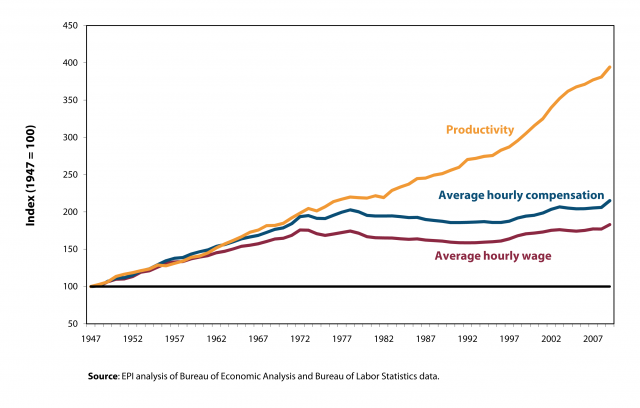
I’ve said this before in other venues, but this really is chart that explains modern America:
Worker-Productivity-Annual-Wage-Compensation
It’s the famous wage/productivity chart, showing the cleavage around 1973 and the far greater discrepancy after the 1980s recession. Basically we’ve been living with the consequences of this wage/productivity gap ever since.

And I tend to think it explains every single economic challenge that we face. It clearly stands in for inequality, as all the wealth accumulated from the productivity gains does go somewhere, mainly into the hands of a rentier class. The over-financialization of the economy sprouted as a way to manage and divert these productivity gains after they didn’t flow to labor, in addition to demanding that these gains not get plowed back into wages. Flat wages play a part in ever-expanding credit bubbles, in the low savings rate and the easy enticement of get-rich quick schemes or simply desperate borrowing to maintain standards of living. The skyrocketing cost of tuition and the subsequent student debt bubble comes with the bill of sale that the only way to escape wage stagnation is to shuffle through the meritocratic assembly line and purchase more and more education (this is a chimera, as wage growth has slowed for college graduates as well, and student debt additionally hinders prosperity). Wage stagnation is at the heart of our low household formation and the implications for construction and building trades. It’s why QE is more and more meaningless to a larger and larger class of wage-flatlined Americans (particularly Treasury purchases, at least in the view of that linked Jackson Hole paper). It defines the middle-class squeeze, the two-income trap, the inadequacy of retirement resources and the flow of so much of that system into the waiting arms of the financial services industry. I’m sure you could come up with something that doesn’t lead back into wage stagnation (climate change? I think I could argue it), but I think my point stands.
Not to mention how this is undermining the functioning of our democratic republic.

More on Snowden and Miranda

Following up on this post....

Looks like I was right:

WASHINGTON (AP) — The U.S. government's efforts to determine which highly classified materials leaker Edward Snowden took from the National Security Agency have been frustrated by Snowden's sophisticated efforts to cover his digital trail by deleting or bypassing electronic logs, government officials told The Associated Press. Such logs would have showed what information Snowden viewed or downloaded.

The government's forensic investigation is wrestling with Snowden's apparent ability to defeat safeguards established to monitor and deter people looking at information without proper permission, said the officials, who spoke on condition of anonymity because they weren't authorized to discuss the sensitive developments publicly.

....

The disclosure of Snowden's hacking prowess inside the NSA also could dramatically increase the perceived value of his knowledge to foreign governments, which would presumably be eager to learn any counter-detection techniques that could be exploited against U.S. government networks.

It also helps explain the recent seizure in Britain of digital files belonging to David Miranda — the partner of Guardian journalist Glenn Greenwald — in an effort to help quantify Snowden's leak of classified material to the Guardian newspaper. Authorities there stopped Miranda last weekend as he changed planes at Heathrow Airport while returning home to Brazil from Germany, where Miranda had met with Laura Poitras, a U.S. filmmaker who has worked with Greenwald on the NSA story.
One has to be pretty naive to think that others with access to the system aren't able to do the same thing.

And if others are, what do you think they're doing with the information they're accessing?

24 August 2013

How do they get away with it?

Because people just look at the headlines.

Case in point. Yesterday one of my Facebook friends posted this picture:


Of course, being the skeptic that I am, I just had to go to the Cato website to check this thing out.  And what you see, of course, is the biggest pile of baloney you can imagine. Here is the report that supposedly proves the point.

I'm not going to go into everything that is wrong with this.  This post from Josh Holland does that pretty well. But I just want to mention one aspect of their "methodology."


The Chris Lane Murder

You know, I'm not one to deny the existence of racial animus, and I happily acknowledge that all people have it to some degree.

But still, to assert that racial animus was the motivation for the Chris Lane murder is just crazy.

I am assuming this is based on these pictures of the three suspects:
Some have jumped to the conclusion that race must be a factor in the murder of white Australian Chris Lane, presumably based on this photo.

But Michael Jones (center photo) is actually white.

Chauncey Luna (right photo) has a black father and a white mother.

And their prospective second victim - they were arrested while trying to find him - was black.

How could anyone, based on these facts, assume that race was a motive?

Love Interests

With our knowledge of how our government tries to use this kind of information - think j Edgar Hoover trying to extort Martin Luther King with evidence of an alleged affair - you've gotta think
this is a lot more widespread practice than they are admitting.

Isn't the whole Petraeus affair a perfect example of this?

I'm still suspicious about how a lot of political sex scandals get exposed. Spritzer and Weiner come to mind immediately.

23 August 2013

More Litigation on the Tax Exemption of Churches

Following up on my post here, the Freedom From Religion Foundation has had another victory, this time in a case on the tax-exemption for churches.

In this case, the FFRF filed suit claiming that the IRS policy of not requiring religious organizations to file annual reports to the IRS, and to apply for tax exempt status, violates the constitution.   The tax code requires exempt organizations to apply for tax exempt status (section 508) and to file annual reports (section 6033).  Churches are exempt from both requirements (section 508(a)(3) and section 6033(c)(1)).

FFRF claims that the exemptions from the filing requirements are unconstitutional under the Establishment Clause.

The district court denied the government's motion to dismiss on standing grounds.

A copy of the decision can be found here.

Note that the Court didn't rule on the application claim.  Apparently, the government argued that since the foundation already filed the application for its exemption (and paid the $5,000 application fee), it's too late to seek redress.  The court has reserved on that question until a later time.

22 August 2013

Snowden and Miranda

I know a lot of people think that the UK (and, indirectly, the US) went overboard when detaining David Miranda.

But honestly, I don't think it was intended as an act of intimidation.

I just think they were trying to figure out what Snowden took.

And it's actually kind of pathetic that this is the only way they have of finding out....

Just About the Stupidest Thing I've Ever Read

Yesterday the Treasury Inspector General came out with another report about the IRS.  This one is not likely to get a lot of press - although it should.  It shows the absolute stupidity of the Republican obsession with "reining in" the IRS.

Back in the late 1990s there was a spate of stories about how the IRS was abusing its power.  The result of all of this was the co-called Taxpayer Bill of Rights, which was formally part of the IRS Restructuring and Reform Act of 1998.  One of the provisions of that act was section 3707, which reads in its entirety as follows:
ILLEGAL TAX PROTESTER DESIGNATION.
(a) Prohibition.--The officers and employees of the Internal Revenue Service--
     (1) shall not designate taxpayers as illegal tax protesters (or any similar designation); and
     (2) in the case of any such designation made on or before the date of the enactment of this Act--
          (A) shall remove such designation from the individual master file; and
          (B) shall disregard any such designation not located in the individual master file.

(b) Designation of Nonfilers Allowed.--An officer or employee of the Internal Revenue Service may designate any appropriate taxpayer as a nonfiler, but shall remove such designation once the taxpayer has filed income tax returns for 2 consecutive taxable years and paid all taxes shown on such returns.
The background of this is that, prior to 1998, the IRS did keep track of tax protesters who, for example, claimed that the Internal Revenue Code was unconstitutional and encouraged others to ignore their tax obligations.  The Act literally prohibits the IRS from from keeping track of such individuals for enforcement purposes. The Senate Finance Committee Report on the law has one sentence as to why it thinks this is necessary:
The Committee is concerned that taxpayers may be stigmatized by a designation as an ‘‘illegal tax protester.’’
Well, we wouldn't want that, now, would we?

21 August 2013

Tax-Exempts' Political Activities

In the last couple of days there have been developments in two cases challenging the ability of tax exempt organizations to engage in political activities.

First, last November the Freedom From Religion Foundation filed a lawsuit against the IRS claiming that it was failing to enforce federal law by permitting churches and other religious organizations to engage in electioneering activities.  The lawsuit alleges that restrictions on such activities are enforced against other kinds of tax-exempt organizations but are not enforced against churches and religious institutions.  On Monday, the District Court denied a motion to dismiss that had been filed by the IRS.  The basis for the motion to dismiss was that (1) the FFRF had no standing, and (2) the suit was barred by sovereign immunity. The Court quickly disposed of both arguments.

Interestingly, a google search has not come up with any news story covering this development in the FFRF case.  Here is a link to the FFRF webpage on the case, where they have just posted the Court's decision on the motion to dismiss.

Second, yesterday it was reported that Rep. Chris Van Hollen of Maryland, who is the ranking member of the House Budget Committee, was going to file suit against the IRS for permitting some political activities for so-called "social welfare organizations" that are exempt from tax under section 501(c)(4).  The basis for the suit is that section 501(c)(4) provides that the exemption is available only for organizations "operated exclusively for the promotion of social welfare."  The basis for the lawsuit is that the use of the term "exclusive" means that any election activities by these organizations should disqualify them from the tax exemption.  Regulations issued by the IRS permit some electing activities by 501(c)(4) organizations, and the suit is seeking an invalidation of those regulations.

That lawsuit was filed today, and a link to the complaint is here.


Climbing Out of My Hole

Sorry for the silence, but the last couple of weeks I have been deeply entrenched in a number of activities and my attention here has lagged.  But I'm back in the saddle again...

08 August 2013

Walking Kids

Reading this reminded me of a story I like to tell people about how child-rearing has changed over the years.

When I was young we lived in a working class, mostly Irish Catholic neighborhood in the south Jersey suburbs of Philadelphia.  One summer my older brother had some surgery and was unable to walk for a couple of months, and since I was the next oldest I became my mother's errand runner.  And one of the errands I regularly ran for her was to go down to the grocery-delicatessen to pick up a few things.  She would give me a list of items she needed and some money and I would walk to the store, which was a half-mile away.  Most of the walk was through our levittown style neighborhood, but I did have to cross a major road to get to the store (and luckily there was a light there so traffic would be stopped for me to cross). When I arrived at the store I would hand the list and money to the owner - everyone knew who I was - and he would proceed to gather together the items on the list and put them in a bag with the change.  Then I would dutifully walk back home with a bag that I could barely get my arms around.

I was seven years old.

Never did the deli-owner shortchange us.

I don't recall ever feeling threatened by anyone.

And just to make things clear, in a lot of ways we were strangers in that neighborhood.  My father was in the military and we had only moved there a couple of years earlier.  By the next summer we were gone.

From everything I read, I can't imagine that any parent would have his or her 7 year-old run an errand like that.  Back then it was commonplace.  And the funny thing is, statistics say that the world is a much safer place today than it it was then.  But people have a lot more fear now than they did then as well.

And that is a shame.


Another Big Case on the Tax Court's Docket

I had missed this when it first came out a month ago.  Apparently, the IRS has slapped Tyco with a tax deficiency of over $1 billion, with includes taxes of $880 million and penalties of $150 million.  And, just to point out, since the tax liabilities relate to the years 1997 through 2000, there's liable to be a hefty amount of interest to be paid as well.

Here is a statement on this dispute that was included in Tyco's quarterly filing with the SEC earlier this month:
On June 20, 2013, we received Notices of Deficiency from the Internal Revenue Service (“IRS”) asserting that several of Tyco International Ltd's (the “Company”) former U.S. subsidiaries owe additional taxes of $883.3 million plus penalties of $154 million based on audits of the 1997 through 2000 tax years of the Company and its subsidiaries as they existed at that time. In addition, we received Final Partnership Administrative Adjustments for certain U.S. partnerships owned by former U.S. subsidiaries with respect to which we estimate an additional tax deficiency of approximately $30 million will be asserted. These amounts exclude interest and do not reflect the impact on subsequent periods if the IRS position described below is ultimately proved correct.

The Company has previously disclosed in its public filings that in connection with U.S. federal tax audits, the IRS has raised a number of issues and proposed tax adjustments for periods beginning with the 1997 tax year. Although we have been able to resolve substantially all of the issues and adjustments proposed by the IRS for tax years through 2007, we have not been able to resolve matters related to the treatment of certain intercompany debt transactions during the period. As a result, the IRS has asserted in the Notices of Deficiency that substantially all of the Company's intercompany debt originated during the 1997 - 2000 period should not be treated as debt for U.S. federal income tax purposes, and has disallowed interest and related deductions recognized on the Company's U.S. income tax returns totaling approximately $2.86 billion. We strongly disagree with the IRS position and we intend to file petitions to the U.S. Tax Court contesting the IRS proposed adjustments. We believe that we have meritorious defenses for our tax filings, that the IRS positions with regard to these matters are inconsistent with the applicable tax laws and existing Treasury regulations, and that the previously reported taxes for the years in question are appropriate.

No payments with respect to these matters would be required until the dispute is definitively resolved, which, based on the experience of other companies, could take several years. We believe that our income tax reserves and the liabilities recorded in our Consolidated Balance Sheet for the tax sharing agreements continue to be appropriate. However, the ultimate resolution of these matters, and the impact of that resolution, are uncertain and could have a material impact on the Company's financial condition, results of operations and cash flows. In particular, if the IRS is successful in asserting its claim, it would have an adverse impact on interest deductions related to the same intercompany debt in subsequent time periods, totaling approximately $6.6 billion, which we expect the IRS to also disallow. 
Just to interpret this last point for you - if they lose this case for 1997-2000, because their interest deductions are disallowed, there is another $2-plus billion at stake for interest on the same loans in later years.

Wow.

Tyco filed its petitions in Tax Court last week.  I'll look them over later today and let you know what I think about its case....

06 August 2013

John Hancock's Taxes

From Bloomberg
JOHN HANCOCK LOSES SUIT OVER $560 MILLION IN U.S. TAXES

John Hancock Life Insurance Co.’s bid for deductions on a series of leveraged lease transactions was denied by the U.S. Tax Court in a decision addressing a $560 million tax dispute.

Judge Harry Haines accepted arguments by the U.S. Internal Revenue Service that “the substance of the transactions is not consistent with their form,” and denied claims for depreciation, rental and interest expense and transaction costs.

“John Hancock did not acquire the benefits and burdens of ownership” Haines wrote of one of the disputed transactions.

The ruling yesterday is the latest court victory for the IRS in challenges to lease-in-lease-out and sale-in-lease-out transactions, commonly called LILO and SILO, which the tax agency has determined are vehicles for improper tax avoidance.

“There have probably been six or seven of them and they’ve ultimately won all of them,” said Mark Allison, a tax attorney with Caplin & Drysdale Chartered in Washington.
Nobody in the tax world is really shocked by this.  As Mark Allison said, this is a kind of transaction that has been litigated extensively over the last 5 years or so, and the IRS has won every time.


01 August 2013