21 February 2011

Happy Presidents Day!

Fun post by Jonathan Bernstein about Presidents Day.  I tend to agree it would be much better if we kept it as a celebration of Washington's Birthday and left it at that.

I did find this sentence most interesting though:
The consensus Three Greatest Presidents are Washington, Lincoln, and (Franklin) Roosevelt, and I wouldn't argue with any celebration of those three.
I think that a significant percentage of Americans think both Lincoln and Roosevelt were rotten presidents.

You can still find a lot of people in the old South who view Lincoln with revulsion for his role in destroying the confederacy and freeing the slaves.  And, of course, for the last thirty-plus years there has been a concerted effort by our economic elites to destroy the New Deal, which in slow, piecemeal fashion has been succeeding.

Even Bernstein's choice as the fourth greatest - Jefferson - is vilified by portions of the right.  Remember how he was removed from a list of important political philosophers from textbooks on world history by the conservative Texas State Board of Education last year? (They did reverse that decision later in the year after nationwide ridicule.)

The divisions of opinions on these presidents exactly match the political battlelines in our country today.

Perhaps there is a consensus among historians on the greatness of these presidents.  But I seriously do not believe there is a consensus among the citizenry.

15 February 2011

Astronomy Pic of the Day


Here is the description from the NASA Website:
Cradled in cosmic dust and glowing hydrogen, stellar nurseries in Orion the Hunter lie at the edge of a giant molecular cloud some 1,500 light-years away. Spanning nearly 25 degrees, this breath-taking vista stretches across the well-known constellation from head to toe (left to right). The Great Orion Nebula, the closest large star forming region, is right of center. To its left are the Horsehead Nebula, M78, and Orion's belt stars. Sliding your cursor over the picture will also find red giant Betelgeuse at the hunter's shoulder, bright blue Rigel at his foot, and the glowing Lambda Orionis (Meissa) nebula at the far left, near Orion's head. Of course, the Orion Nebula and bright stars are easy to see with the unaided eye, but dust clouds and emission from the extensive interstellar gas in this nebula-rich complex, are too faint and much harder to record. In this mosaic of broadband telescopic images, additional image data acquired with a narrow hydrogen alpha filter was used to bring out the pervasive tendrils of energized atomic hydrogen gas and the arc of the giant Barnard's Loop.
You need to go to the NASA website to see the effect of sliding your cursor over the picture.  Here is the link.

Quote of the Day

"Independence? That's middle-class blasphemy. We are all dependent on one another, every soul of us on earth."
                                               -- George Bernard Shaw

Trickle-Down v. Bubble-Up

A good article by Richard Wolff of the Guardian on the budget consensus in Washington.

I can remember when the mortgage crisis hit in late 2008 - when financial institutions were holding bad mortgages because the housing market had collapsed and people couldn't pay their mortgages.  And I remember thinking there are two ways to help the banks get through this.  One was to subsidize them directly to cover their losses.  The second was to subsidize homeowners so they could pay their mortgages. If the homeowners paid their mortgages, the banks wouldn't suffer their losses.  The second approach seemed to me to kill two birds with one stone.

This is the essence of Wolff's "trickle-down" v. "bubble-up" economic policies.  Approach 1 is trickle down, approach 2 is bubble-up.  In either way, the banks are helped.  So why did they, and so many others, insist that trickle-down was the only way to do this?

I have my own thoughts on this one, but I'd love to hear yours.

14 February 2011

How Conservative Lies Are Made and Spread

From Jesse Singal of The New Republic:

Perhaps the best recent example is a chart that has been racing around the conservative blogosphere for the last few months. According to its findings, a one-parent family with two children making $14,500 a year has more disposable income than an identical family making $60,000 a year; a family making just $3,625 a year doesn’t quite do as well as the one making $60,000, but it comes close. Those who publish the chart claim it shows that it pays to be poor in America because of government largesse, courtesy of Obama and the Democrats, that the middle class doesn’t have access to.

Problem is, the chart is full of errors. I traced it back to the man who made it, a newspaper publisher in Mississippi, and found that the math, methodology, and logic he used to generate the chart, as well as an op-ed he wrote to accompany it, are wholly unsound. To make matters worse, despite the chart’s cringe-worthy flaws, very few outlets on the Internet, from small-scope blogs to a handful of forums hosted by major national publications, bothered to fact-check it.
Read it and weep.

Quote of the Day

I'm not a big fan of Kissinger, but I do agree with him on this:
Ninety percent of politicians give the other ten percent a bad reputation.

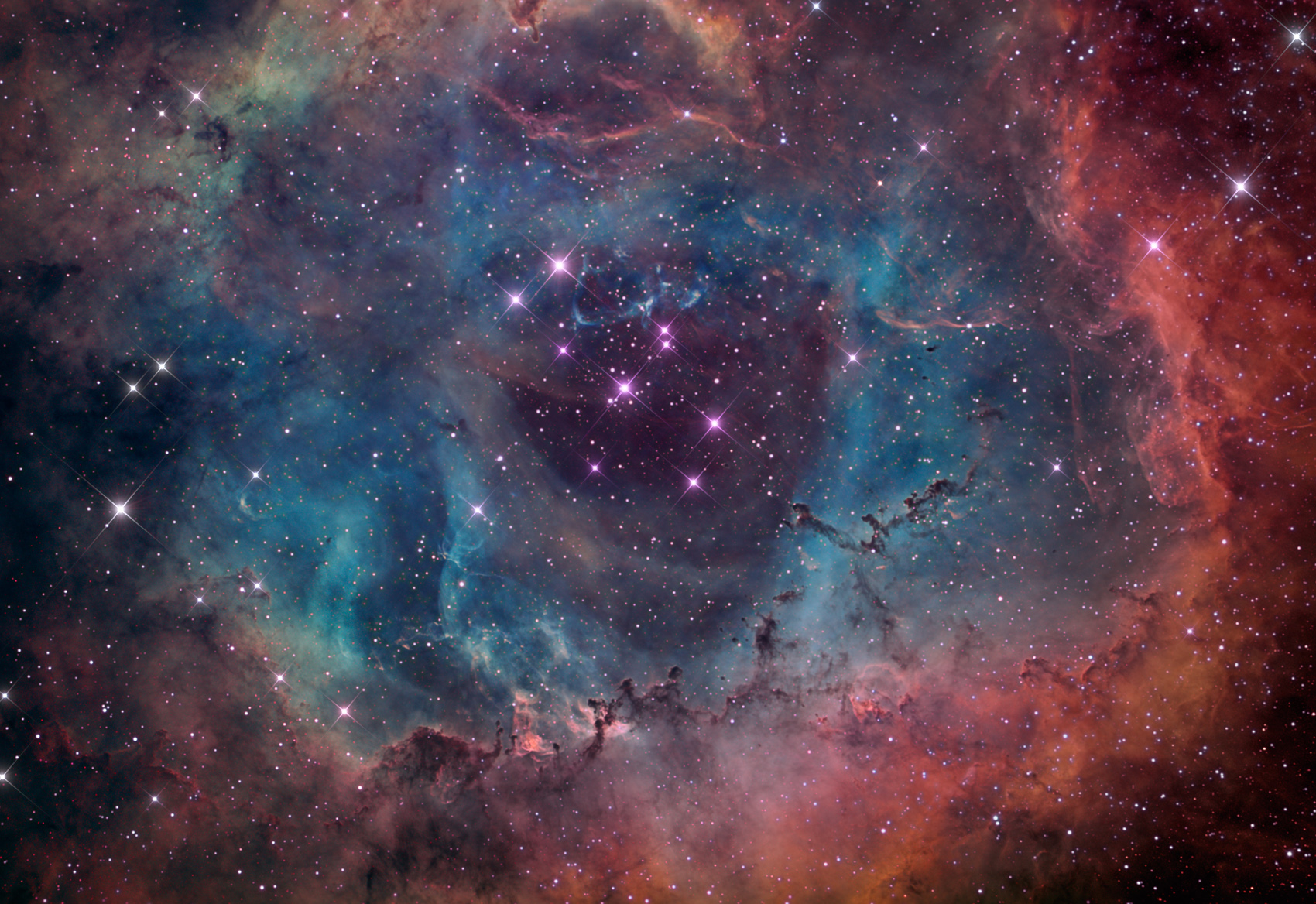
Astronomy Pic of the Day


Here is the description from the NASA Website:
Would the Rosette Nebula by any other name look as sweet? The bland New General Catalog designation of NGC 2237 doesn't appear to diminish the appearance of this flowery emission nebula. Inside the nebula lies an open cluster of bright young stars designated NGC 2244. These stars formed about four million years ago from the nebular material and their stellar winds are clearing a hole in the nebula's center, insulated by a layer of dust and hot gas. Ultraviolet light from the hot cluster stars causes the surrounding nebula to glow. The Rosette Nebula spans about 100 light-years across, lies about 5000 light-years away, and can be seen with a small telescope towards the constellation of the Unicorn (Monoceros).